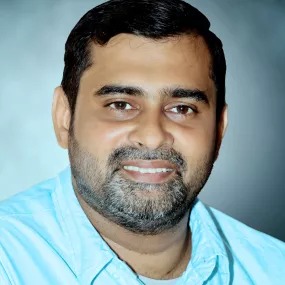
Mr. Ashok Kumar RAJAMANI
Digital Design Manager / 5D Project Manager, Exyte
Ashok Kumar has over 23 years of professional experience in the design, construction, start-up, and commissioning of process gas, chemical, slurry, and high purity facility systems for a wide range of high-tech facilities such as semi-conductor and pharmaceutical.
Ashok Kumar understands how a Base Build design satisfies the requirements of manufacturing process tool parameters and values. He has the experience to fully evaluate the best energy modelling options based on the correlation between the energy balance points of buildings and the geographical energy in their layouts. The best option is evaluated for incorporating into energy recovery and/or renewable energy initiatives.
In his current role as the Design Manager (Digital Tool Install) / 5D Project Manager, Ashok Kumar provides and ad-vises on conceptual / detailed structural designs and technical support to project teams during the construction phase of projects for Advanced Technology Facilities. Many years of successful experience in digital transformation & initiatives, vendor management, Building Information Modelling (BIM) management, mechanical, electrical, piping, engineering design / drafting and construction. A variety of successful projects for DTI, infrastructure, institutional, health care, mixed development, residential and industrial experience that includes supervision, training, field surveying, estimating, conceptual layout, 3D modelling, 4D construction sequence, fabrication drawings, material take-off, 5D costing and BIM+FM Integration (7D-BIM)
Ashok Kumar holds a Master of Engineering in Technology Management from the University of South Australia and a VDC certification from Stanford University.
Presentation Title
Digital Tool Install for Next-Gen Microelectronic Fabs
Abstract
The world is digitally evolving at a rapid pace thus causing the demand of semiconductor chips to surge. Majority of the growth is driven by data centers, computing, wireless communication, and automotive. The global wafer produc-tion capacity is expected to increase by approximately 50% by 2030.
We recognize the importance of providing our wafer manufacturing clients with environmentally sustainable solutions and are embracing innovation and technology throughout the entire design and construction process. All these to elevate microelectronics fabs to be a lot smart-er in terms of building and operating them.
At Exyte, digitalization is more than just a buzz word. Digitalization embodies the use of technology to enhance the way we work with to meet the demands of tomorrow and enhance value to the entire project delivery. At the core of our digitalization roadmap is our Digital Tool Install (DTI) solution.
In this presentation, we will share how DTI is the data-driven solution that will enhance the way we deliver next generation high-tech facilities. Incorporating an engineering management platform that brings design and tool install data management into one seamlessly integrated platform which allows seamless integration between the Base Build and Tool Install. The use of smart P&IDs to create data rich and intelligent schematics that enhance accuracy and efficiency with embedded design and specification data. Clash-free construction scheduling, logistics planning, optimal resource utilization, progress tracking and material management are all integrated with 4-D BIM. On top of this, 5D BIM allows for more accurate and faster quantity take-offs, enabling significant reduction in time for cost estimating and enhance cost forecast and estimation. In order to create an accurate digital representation of the current conditions complete with the new project over-laid, progressive laser scanning is used. Tight supply chain integration creates cohesion and increases connectivity throughout the entire value chain, giving all project stakeholders the flexibility to meet demands as they arise. The DTI solution redefines the next generation of project delivery and is a game changer in the design and operation of next-generation semiconductor facilities.